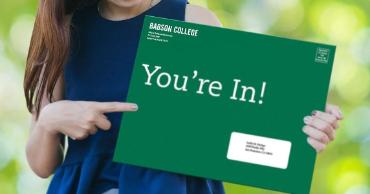
Academic Motivation
Interest in learning and a willingness to challenge oneself
At Babson, we look for students who will succeed in our rigorous academic environment, while nurturing and pursuing their passions outside the classroom. Check out the most current incoming class profile. Read about our updated testing policies. And, learn more about the evaluation criteria that we use to make admission decisions.
All applicants are considered in a contextual and holistic way. While the greatest focus is placed on your four-year performance, we also look at your, optional standardized test scores, and leadership, creativity, and enthusiasm. Other factors include:

Interest in learning and a willingness to challenge oneself

On average, admitted students had high school grades between A- and B+

Involvement in activities and/or work experience

Successful completion of accelerated coursework, honors, or AP/International Baccalaureate credit
If you are applying to Babson, you are among top-notch students and driven peers. You have carried four to five courses per year in English, mathematics, social science, laboratory science, and foreign language. And you have taken mathematics through pre-calculus.
Students who attend Babson will be required to submit a final high school transcript, GED, or equivalent, indicating successful completion of high school in good academic standing. Babson College reserves the right to rescind an offer of admission—read our policy here.
As part of our application process, we require applicants to submit responses to two writing supplement questions. Through these submissions we are able to learn more about each applicant, their interests and aspirations, and their perspectives and experiences.
When applying you will be asked to submit two writing supplements in response to the following prompts:
1. The Babson education prepares students for all types of careers across business, entrepreneurship, social innovation, and more. Tell us about your interest in this area of study and in Babson specifically.
You are invited to respond with either a traditional essay (500 words maximum) OR a one-minute video. Whichever you choose, no preference is given to either format in admission decisions.
2. A defining element of the Babson experience is learning and thriving in an equitable and inclusive community with a wide range of perspectives, experiences, and interests. Please share something about your background, lived experiences, or viewpoint(s) that speaks to: (1) your commitment to promoting access, connection, or understanding across differences; and/or (2) how you will contribute to and learn from Babson's collaborative community.
Please respond to this prompt with an essay (250 words maximum).
We understand that applicants may choose to use generative AI to support their application process. However, it’s essential that your materials remain authentic and reflect your own experiences and perspectives. The final work you submit with your application should authentically reflect your lived experiences, interest in Babson College, and future goals. If you choose to use generative AI, we recommend that you use this tool to enhance your original work and not create it. We value hearing your authentic voice and perspective, so ensure that your responses genuinely reflect who you are and what you hope to achieve at Babson.
Choose from more than 20 concentrations and create flexible learning experiences focused on addressing tomorrow’s problems today. Connect with your professors—100% of courses are taught by professors (zero teaching assistants). And, dive into Foundations of Management and Entrepreneurship (FME), where you’ll create and run a business of your own in your first year.
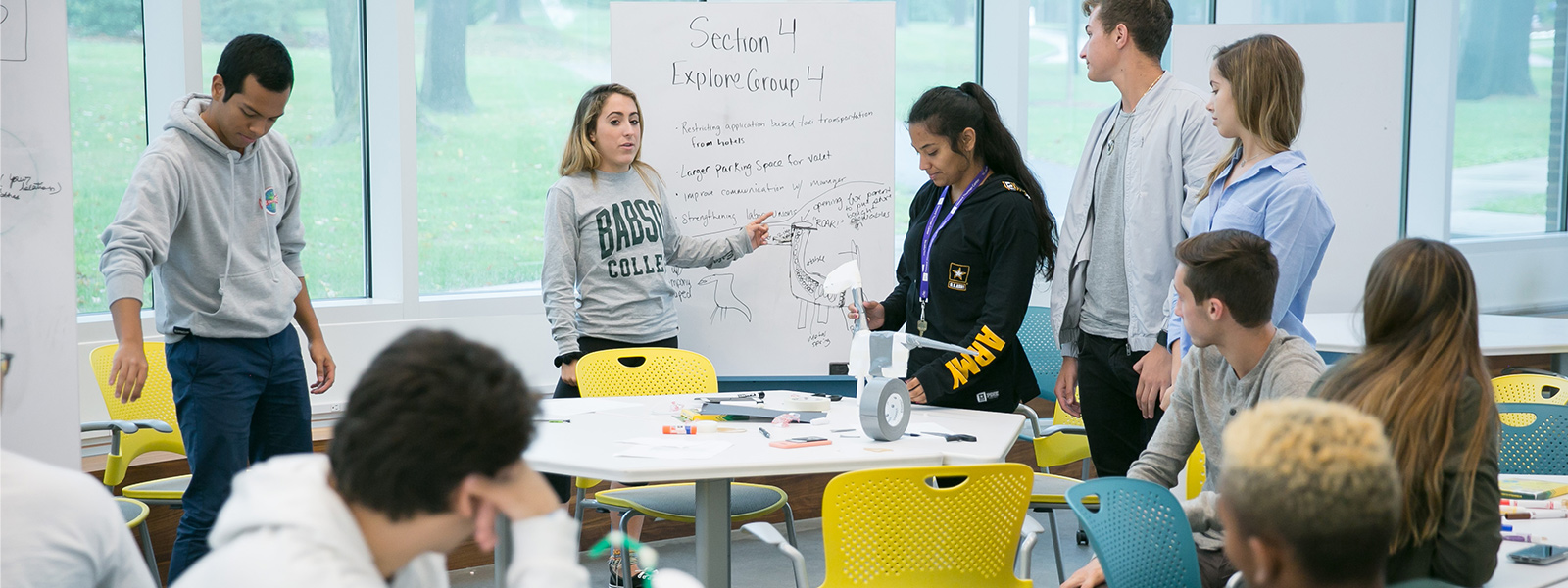
Experience Babson’s new curriculum—integrating disciplines across programs and balancing action with experimentation, creativity, and sustainability. You’ll gain a well-balanced college education that aligns with your career aspirations.
Learn More About the CurriculumBabson continues the Test-Optional Policy for first-year applicants. Applicants may still submit test scores voluntarily. All applications will be reviewed for consideration in a holistic manner taking into account academic performance and academic rigor during high school(s), community service, co-curricular activities, and other aspects of the application and candidate’s portfolio.
Additionally, all applicants will be considered for merit scholarships regardless of test score submission.
Babson is test-optional for first-year applicants.
If you choose to provide the SAT or ACT, you may provide self-reported test scores. Once admitted, students who enroll at Babson must submit official scores.
If you have taken the SAT or ACT more than once, Babson will superscore (use the best individual section scores) in reviewing your application. Babson College does not require the optional writing section on either the SAT or ACT.
SAT reporting code 3075. ACT reporting code 1780.