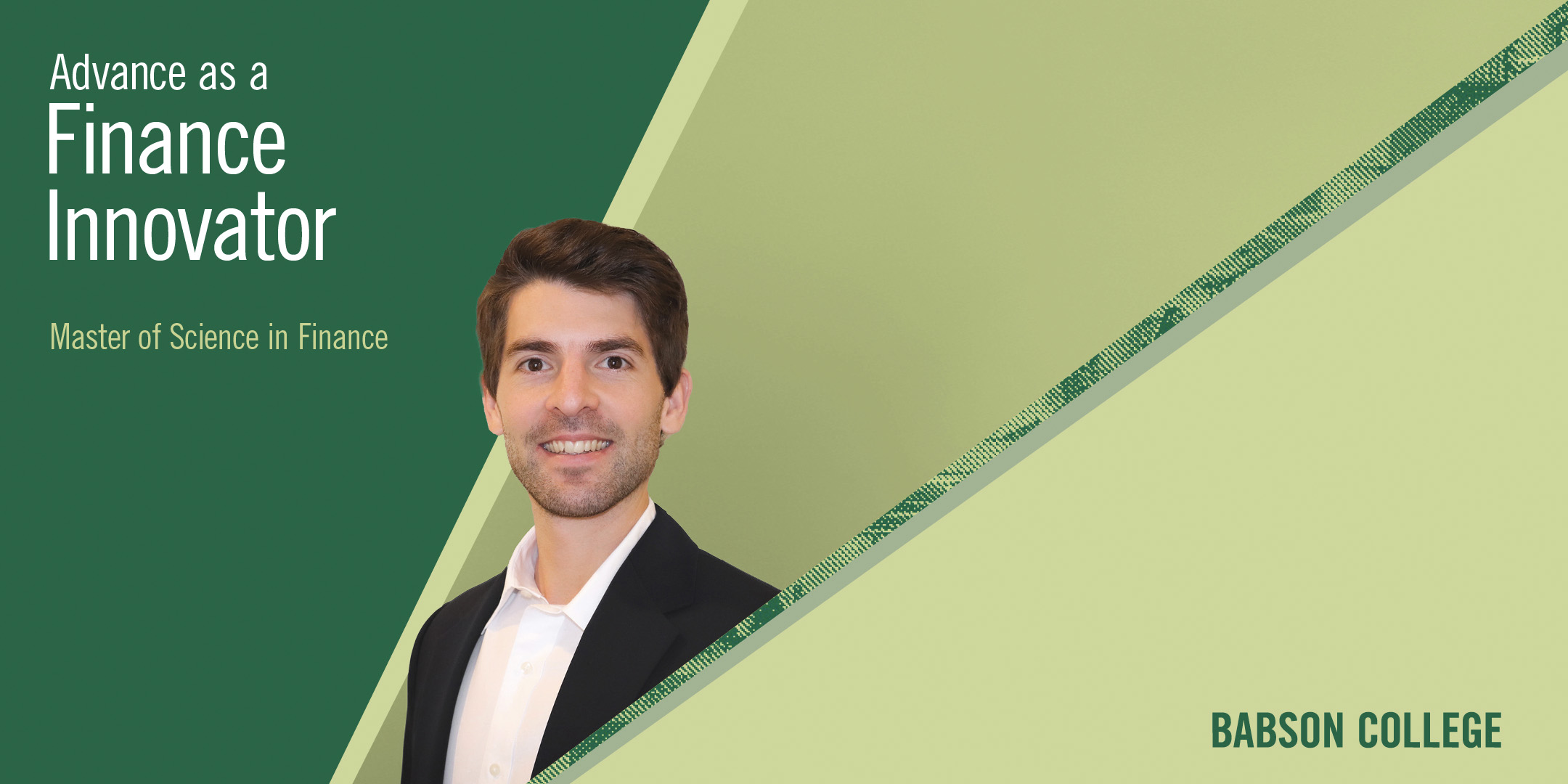
A Master’s to Unlock New Opportunities
“I knew that I wanted to move my career into more of the business side of things,” says David. “I knew that I needed some more hard skills and wanted to get a master's.”
As a competitive athlete, David valued preparation. “I've learned that you have to do everything that you can to get yourself ready for the match. And I apply that to anything I do in life,” he says. “That's why instead of just switching career paths and going into business directly, I wanted to prepare myself in the best way possible by getting a master's, by deepening my knowledge and also learning from other professionals in the industry.”
At the time, he was living in Boston and started where many start their grad school search—Google. “I searched for good programs, and Babson came up time and time again as one of the strongest business schools in terms of entrepreneurship,” says David. “That's something that caught my attention because I wanted to develop technical skills in finance, but also I wanted to learn a little bit more about how businesses are created in general. I also thought that having an entrepreneurial mindset would help me in any career path that I chose, and that's why I ended up choosing Babson."
He chose the 9-month Master’s of Finance, with the goal of quickly re-entering the workforce. Initially, he admits he was a bit overwhelmed. He didn’t have much of a finance background and knew he had a rigorous course of study ahead. Over time, Babson’s program structure helped him build competence and confidence by familiarizing him with terms, knowledge, and application.
Courses Centered on Real-World Problem-Solving
David felt every class he took offered value. “They were all phenomenal,” he says. In particular, he liked a course called “Finance for New Ventures,” which walks students through how a company is funded from the beginning. “That’s a very interesting process because you get to see it from the entrepreneur side … how they go about raising money, different series, etc.,” says David. “But also you see that perspective from the investor side.” He adds that the professor brought in professionals from the venture capital world, and they had a chance to understand a bit about the challenges and opportunities that investors weigh.
Another class David took, “Financial Data Analysis,” covered python, a data language that he wasn't very familiar with. “What that class taught me is that it's important to learn to figure things out on your own,” he says. “Not everything is going to be given to you, and you have to try to use all the tools that are in your hands to figure out any problem.” That’s a lesson that has proved useful to him in his professional career time and time again.
Keeping an Open Mind: The Entrepreneurial Way of Thinking
David says his professors were helpful and supportive not only in the classroom but also personally and professionally. From the faculty, David learned how to apply financial theories and entrepreneurial thinking to real-world problems.
Babson inspired in him a new way of problem solving and an openness to career opportunities. “Just because something has been done a certain way, doesn’t mean it has to keep being done that way. That's one of the biggest lessons I got from Babson,” he says.
Today, David is a Senior Financial Analyst for Interparfums in New York, a global fragrance business that produces and distributes some of the world’s leading brands. “All the basics and the finance knowledge that I gained at Babson, I'm using on a day-to-day basis,” says David. “But to me, what sets Babson alumni apart is something more.” It’s the entrepreneurial way of thinking that David values most.
“There are a lot of things that you can learn in the job that most people can learn, but certain things are much more difficult,” he says, “Like being proactive, learning how to change processes, or not being afraid to speak up when you believe there is a better process to implement.” Those are skills he gained at Babson.