students
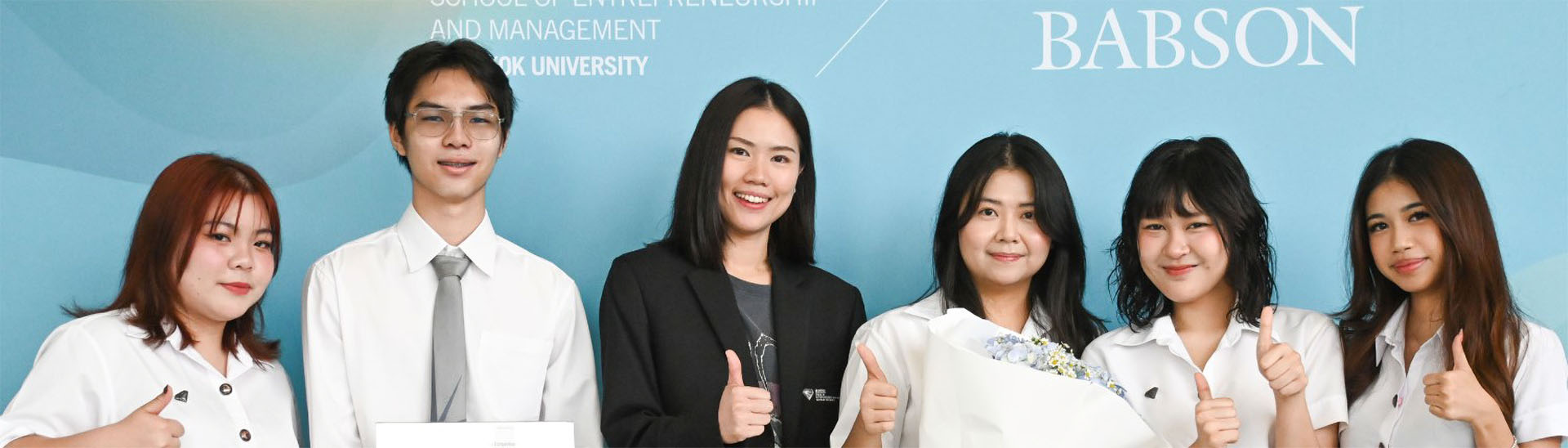
The Babson Collaborative Global Student Challenge is an international entrepreneurship competition that invites undergraduate and graduate students from Babson Collaborative member institutions to develop innovative business concepts that address one or more of the United Nations Sustainable Development Goals (SDGs). Working in teams, students apply entrepreneurial thinking, opportunity identification, and feasibility analysis to create solutions with the potential to become new ventures.
The Global Student Challenge begins with institution-level competitions and culminates in a global competition where top teams present a five-minute feasibility analysis of their business concept to expert judges. Through this experience, students strengthen their skills in innovation, critical thinking, and social impact while gaining exposure to a global network of entrepreneurial educators and peers.
students
universities
countries
entrepreneurial projects
The Babson Global Student Challenge has inspired us to believe that young entrepreneurs can create meaningful change through innovation and sustainability.”
The 2026 Babson Collaborative Global Student Challenge marked another milestone in the growth of this global entrepreneurship initiative, engaging 4,073 students, from 33 member institutions across 24 countries, who developed 1,280 innovative projects addressing the United Nations SDGs. This year also welcomed five new participating institutions, further expanding the Challenge’s global reach and impact:


Together, these students demonstrate the transformative power of entrepreneurship to drive innovation, create social impact, and advance progress toward a more sustainable future.
students
collaborative member institutions
countries
projects
A total of 52 teams representing 29 Babson Collaborative member institutions across 21 countries advanced to the semi-finals of the 2026 Babson Collaborative Global Student Challenge. From this group, 11 teams representing eight member institutions in seven countries were selected to advance to the finals, demonstrating the breadth of entrepreneurial talent and innovation across the Babson Collaborative network.
Bangkok University, Thailand
Cassapure is a water filtration solution that turns agricultural waste from cassava peels into high-performance activated carbon for industrial wastewater treatment.
Team Members
Universidad de Piura, Perú
Deplax is a biotechnology-based solution that uses microorganisms to process non-recyclable plastics that would otherwise accumulate in the environment.
Team Members
American University of the Middle East, Kuwait
Al-Nakhla transforms palm waste from Kuwaiti farms into a biodegradable bio-gel that helps retain water in soil and supports sustainable farming.
Team Members
The UN Global Goals are particularly important to us because they show that innovation and responsibility must go hand in hand. As young entrepreneurs, we believe we have the opportunity to create solutions that contribute to a more sustainable, inclusive, and better future on a global scale.”
students
collaborative member institutions
countries
projects
A total of 12 teams representing 11 Babson Collaborative member institutions across seven countries advanced to the semi-finals of the 2026 Babson Collaborative Global Student Challenge. From this group, six teams representing six member institutions in four countries were selected to advance to the finals, demonstrating the breadth of entrepreneurial talent and innovation across the Babson Collaborative network.
EDEM Business School, Spain
Six Move creates professional clothing with invisible safety reinforcements to protect urban commuters from accidents, promoting safer and more sustainable city mobility.
Team Members
Universidad Técnica Particular de Loja, Ecuador
ReSense is an AI-powered, self-learning app for people with visual disabilities that uses personalized pathways to improve education and employability, reducing barriers to workforce inclusion.
Team Members
EAE Business School, Spain
NEXA transforms pharmaceutical waste into a data-driven scalable sustainability infrastructure, at the intersection of health, clean oceans/rivers, ESG, and smart waste management.
Team Members
The Global Student Challenge was a chance to test our ideas globally. We had to weigh factors like plausibility and social impact to craft a catchy, compelling pitch. The teamwork we needed challenged us on a professional and personal level.”
Social Impact Patrons are donors with a shared belief in, and commitment to, the UN Global Goals. By sponsoring cash prizes, Patrons hope to inspire greater participation in the Challenge and help equip winners to take their concept to the next level!